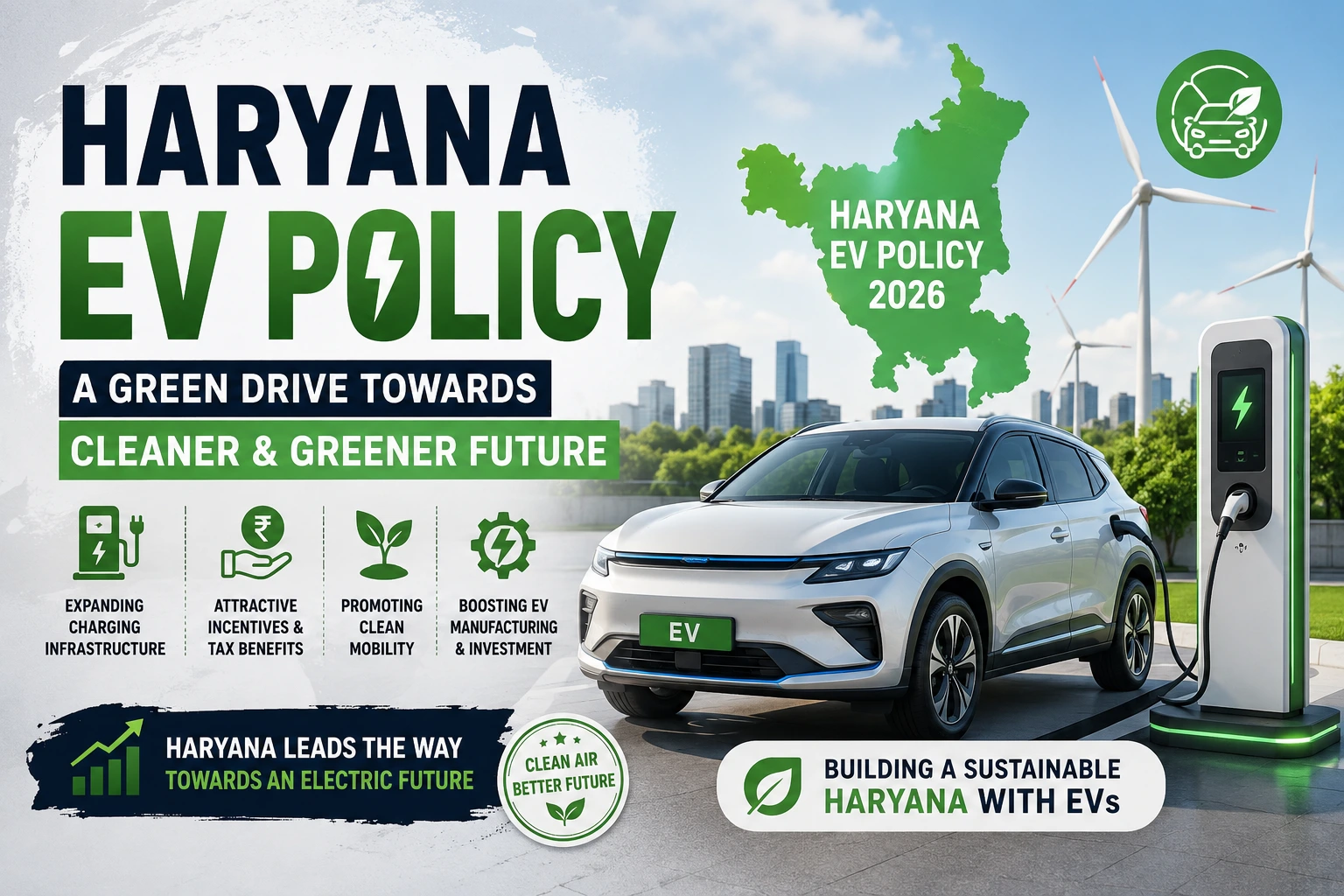
If you’re planning to buy an electric vehicle in Haryana, there’s genuinely good news waiting for you. The Haryana EV Policy has been bringing real financial benefits to buyers across the state, and after going through all the details, I can tell you it’s one of the more generous EV policies in India right now. In this blog, I’ll break down everything about the Haryana EV Policy 2026 – the subsidy amounts, road tax benefits, eligibility, and exactly how you can claim it, all explained in simple language.
What Is the Haryana EV Policy?
The Haryana EV Policy was originally introduced in 2022 to speed up the state’s shift toward electric mobility, with the incentives remaining valid for five years from the date of notification. The policy isn’t just about helping individual buyers either ,it was designed with three broad goals in mind: building EV manufacturing capacity within the state, creating a strong charging infrastructure network, and offering demand side incentives that make EVs more affordable for everyday buyers.
What makes Haryana’s approach interesting is that it works alongside the central government’s incentive schemes rather than replacing them, which means buyers in the state can often stack multiple benefits together.
Haryana EV Subsidy: How Much Can You Save?

This is the part most people care about the most, so let’s get into the numbers directly.
For pure electric vehicles priced between ₹15 lakh and ₹40 lakh, the Haryana government offers the first 1,000 buyers a purchase incentive of 15% of the ex-showroom price, up to a maximum of ₹6 lakh, whichever amount turns out to be lower. This subsidy was temporarily paused after March 2024 but has since been restored by the state government, following an announcement by Industries and Commerce Minister Rao Narbir Singh, in a clear signal that Haryana wants to keep pushing EV adoption forward.
Here’s a quick breakdown of the incentive structure across different vehicle categories:
- Electric cars (₹15 lakh – ₹40 lakh): 15% of ex-showroom price, capped at ₹6 lakh, for the first 1,000 buyers
- Electric two-wheelers: State subsidy aligned with central schemes, typically up to ₹30,000 per vehicle depending on battery capacity
- E-carts and e-rickshaws: A subsidy incentive of ₹25,000 per vehicle
- E-tractors: 50% of the ex-showroom price, capped at ₹5 lakh, for the first 1,000 units
- E-buses: 10% of the ex-showroom price, up to ₹10 lakh, for the first 200 units purchased in the state
It’s worth noting that imported electric cars are also eligible under this policy, though the subsidy for such vehicles is capped at ₹10 lakh.
Road Tax and Registration Benefits
Beyond the direct purchase subsidy, the Haryana EV Policy also removes some of the recurring costs associated with vehicle ownership. EV buyers in the state get a 100% exemption on road tax, which applies for the entire duration of the policy period. On top of that, electric vehicles are also exempted from paying state toll tax, which can add up to meaningful savings if you’re someone who drives frequently across the state.
Vehicle registration is another area where EV buyers benefit. Electric vehicles get priority registration with a minimal token fee of just ₹100, making the overall registration process both faster and cheaper compared to conventional vehicles.
Charging Infrastructure Incentives
A big part of what makes an EV policy effective is whether it actually solves the charging problem, and Haryana has put real thought into this. The state offers a 25% capital subsidy, up to ₹10 lakh, for setting up public fast-charging stations. Higher incentive rates are also available for chargers installed along state highways and key transport corridors, encouraging private players and businesses to build out charging infrastructure in high-traffic areas.
The government is also actively promoting solar-powered charging stations and providing incentives on open access charges, which supports a more sustainable charging ecosystem in the long run.
Benefits for EV Manufacturers
The Haryana EV Policy isn’t limited to buyers and charging operators. It also offers a strong package of incentives for companies manufacturing EVs or EV components within the state:
- 100% reimbursement of stamp duty
- Exemption in electricity charges for a period of 20 years
- 50% reimbursement of SGST filed by EV manufacturers, extended over 10 years
- Employment generation subsidy of ₹48,000 per employee, per year, for 10 years
- Capital subsidy for EV and EV component manufacturing units, including a 25% subsidy on fixed capital investment, capped at ₹50 crore
This manufacturing-first approach makes sense given Haryana’s strong industrial base and its close proximity to the Delhi-NCR region, which is one of India’s largest vehicle markets.
Support for EV Research and Development
The policy also sets aside dedicated support for research institutions working on EV technology. R&D institutions can receive up to 50% of their project cost, capped at approximately ₹1 crore, while organisations that set up a dedicated EV R&D facility can receive an incentive of up to ₹5 crore. Additionally, the first 20 polytechnics and industrial training institutes get a one-time subsidy of ₹25 lakh each to support EV-focused technical training.
How to Apply for the Haryana EV Subsidy
If you’re planning to buy an EV and want to claim the subsidy, the process has been kept fairly straightforward and digital, with no need for agents or middlemen:
- Buy from an approved dealer: Purchase your electric vehicle from a properly state-registered dealer
- Apply online: Submit your vehicle details on the official Haryana EV subsidy portal within 90 days of purchase
- Submit documents: You’ll need to upload your invoice, registration certificate (RC), battery registration certificate, and the owner’s Aadhar card
Since subsidy availability, exact rates, and eligibility windows can change from time to time, it’s always a good idea to confirm the latest figures with the Haryana transport department or an authorised dealer before finalising your purchase.
Why Haryana’s EV Push Matters
Haryana faces a genuine air quality challenge, particularly in cities like Gurugram and Faridabad, where vehicular emissions contribute heavily to pollution levels. By pushing EV adoption through strong financial incentives, the state is directly targeting one of the biggest sources of nitrogen oxide and carbon dioxide emissions in the region. It’s also a move that aligns with India’s broader target of achieving carbon neutrality by 2070.
Given Haryana’s industrial strength and its location right next to Delhi, the state is also positioning itself as a serious hub for EV manufacturing, not just EV consumption, which could bring long-term economic benefits alongside the environmental ones.
Frequently Asked Questions
Q1. How much subsidy does Haryana offer on electric cars? Haryana offers 15% of the ex-showroom price, up to a maximum of ₹6 lakh, for the first 1,000 buyers of electric cars priced between ₹15 lakh and ₹40 lakh.
Q2. Is road tax exempted on electric vehicles in Haryana? Yes, electric vehicles registered in Haryana get a 100% exemption on road tax for the entire policy period.
Q3. How can I apply for the Haryana EV subsidy? You need to buy your EV from a registered dealer and apply online on the official Haryana EV subsidy portal within 90 days of purchase, along with the required documents.
Q4. Does the Haryana EV Policy cover two-wheelers as well? Yes, electric two-wheelers are eligible for a state subsidy of up to ₹30,000, depending on the battery capacity.
Q5. Are imported electric cars eligible for the Haryana EV subsidy? Yes, imported electric cars are eligible, though the subsidy amount for such vehicles is capped at ₹10 lakh.
Final Thoughts
The Haryana EV Policy stands out as one of the more comprehensive state-level EV frameworks in India, covering everything from buyer subsidies and road tax exemptions to manufacturing incentives and charging infrastructure support. If you’re in Haryana and considering an electric vehicle, this is genuinely a good time to take advantage of these benefits, especially with the purchase subsidy limited to the first 1,000 buyers in the eligible price bracket.