

Updated guidance — 5 October 2026: Consult your owner’s manual before changing charge limits. See the battery-care guide with manufacturer sources for examples of differing instructions.
If you’ve recently switched to an electric vehicle, there’s a good chance you’re treating your EV battery a little like your phone battery , charging it fully every night and not thinking twice about it. I get it, it’s a natural habit. But after going through what actually damages EV batteries over time, I realised a lot of everyday charging and driving habits are quietly shortening battery life without owners even realising it. In this blog, I’ll walk you through the five most common mistakes that reduce EV battery life, and more importantly, how you can easily avoid each one.
Why EV Battery Habits Actually Matter
Before we get into the mistakes, it helps to understand why this topic deserves attention in the first place. The battery is the single most expensive component in your EV, and unlike a fuel tank, it degrades a little every time you charge and use it. This is completely normal and expected. But certain habits speed up that degradation far faster than necessary, which can mean noticeably reduced range and a shorter overall battery lifespan a few years down the line. The good news is that almost all of these mistakes are easy to fix once you know about them.
Mistake 1: Ignoring Your Model’s Charge Instructions
Battery chemistry and the vehicle’s charging instructions matter. Charging to 100% is not automatically a mistake: some models specify periodic full charging, while others recommend a lower daily target.
The fix: Follow the owner’s manual for your exact battery, model and market, including any full-charge interval. Avoid applying one generic 20–80% rule to every EV.
Mistake 2: Letting the Battery Drop Too Low Too Often
On the flip side of the first mistake, regularly letting your battery drain down to very low levels, especially below 10-15%, is just as harmful as constant 100% charges. Deep discharges put excessive stress on the battery cells, and if a battery is left sitting at an extremely low charge for an extended period, it can suffer damage that’s difficult, or in some cases impossible, to reverse.
The fix: Try to plug in your EV before it drops below 20%. If you know you’ll be away from a charger for a few days, top up the battery beforehand rather than letting it run close to empty. And if you’re storing your EV for an extended period, aim to keep the charge level around 50%, rather than leaving it nearly empty or completely full.
Mistake 3: Relying Too Heavily on Fast Charging
DC fast chargers are genuinely convenient, especially on long drives, and there’s nothing wrong with using them occasionally. The problem starts when fast charging becomes your everyday, go-to charging method instead of an occasional convenience. Fast charging pushes a large amount of current into the battery in a short span of time, which generates more heat, and repeated heat exposure over months and years is one of the biggest contributors to faster battery degradation.
The fix: Use a regular home or slow AC charger for your daily charging routine, and save DC fast charging for situations where you genuinely need a quick top-up, like during a highway trip. Your battery will thank you for it in the long run, both in terms of health and resale value.
Mistake 4: Exposing Your EV to Extreme Heat
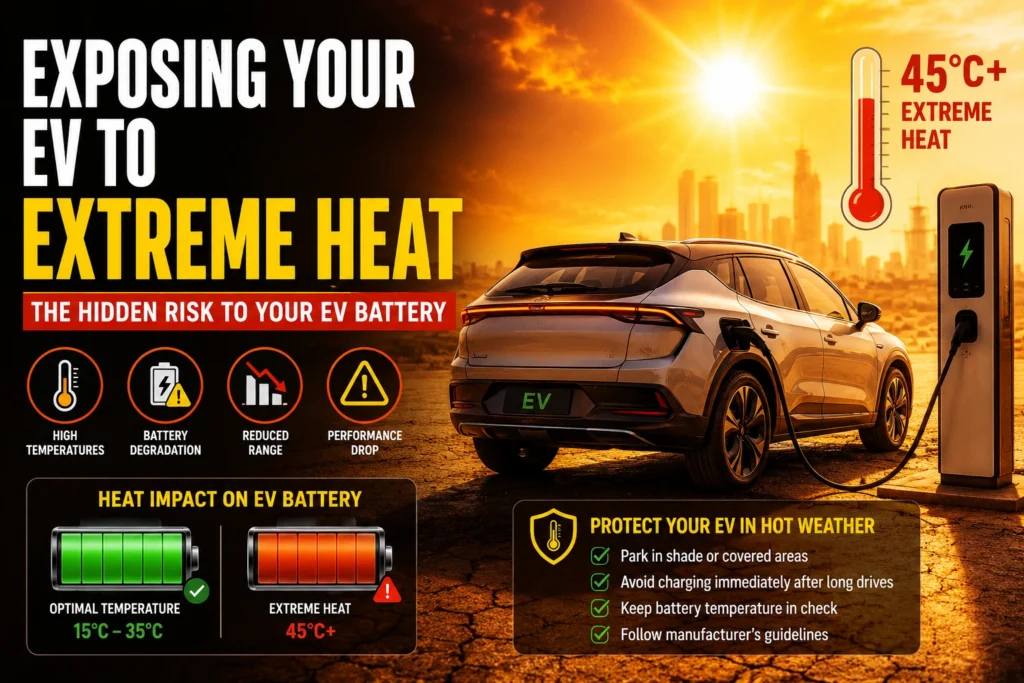
This one is especially relevant if you’re driving in India, where summer temperatures regularly cross 40°C in many regions. Extreme heat is one of the fastest ways to accelerate battery degradation. Parking your EV in direct sunlight for hours, or leaving it exposed to high ambient temperatures for long durations, puts real thermal stress on the battery pack, even when the car isn’t being driven.
The fix: Whenever possible, park your EV in a shaded area or a covered garage, especially during peak summer months. If your EV has a scheduled charging or climate pre-conditioning feature, use it to your advantage – charging during cooler parts of the day, like early morning or late evening, can meaningfully reduce heat-related stress on the battery.
Mistake 5: Ignoring Basic Battery Maintenance
Many EV owners assume electric vehicles are completely maintenance-free, and while it’s true that EVs need far less maintenance than petrol or diesel cars, “less” doesn’t mean “none.” Skipping periodic battery health checks, ignoring software updates that often include battery optimisation improvements, or neglecting cooling system inspections can all quietly contribute to faster degradation over time.
The fix: Stick to your manufacturer’s recommended service schedule, even if the car feels like it’s running perfectly fine. Keep your car’s software updated, since manufacturers frequently roll out updates that improve battery management and charging efficiency. And if you ever notice your range dropping unusually fast or charging times becoming inconsistent, get your battery checked sooner rather than later, since catching issues early is always cheaper than dealing with major degradation later.
Bonus Tip: Use Regenerative Braking Wisely
While this isn’t strictly a “mistake” in the traditional sense, it’s worth mentioning. Aggressive driving, hard acceleration, and heavy braking all put extra strain on the battery. Making good use of regenerative braking, by easing off the accelerator early and letting the car recover energy naturally, not only improves your range but also reduces unnecessary stress on the battery over time.
Frequently Asked Questions
Q1. Is charging to 100% always bad? No. Use your model’s recommended daily limit and periodic full-charge instructions. Chemistry alone does not replace the owner’s manual.
Q2. Does fast charging damage EV batteries? Occasional fast charging is fine, but relying on it as your primary charging method generates more heat and can speed up battery degradation over time.
Q3. How does hot weather affect EV battery life? Extreme heat puts thermal stress on the battery, which accelerates degradation. Parking in shade and charging during cooler hours can help reduce this impact.
Q4. What is the ideal daily charge range? Use the vehicle’s specified target; a universal 20–80% range is not appropriate for every model.
Q5. Do EV batteries need regular maintenance? Yes, while EVs need far less maintenance than petrol or diesel cars, periodic battery health checks and software updates are still important for long-term battery health.
Our thoughts
Most of the habits that damage EV batteries aren’t dramatic or obvious , they’re small, everyday choices that quietly add up over months and years. The good news is that avoiding these five mistakes doesn’t require any extra effort or cost; it simply means adjusting a few habits around how you charge, park, and maintain your EV. Get these basics right, and your battery should comfortably serve you well for years to come.